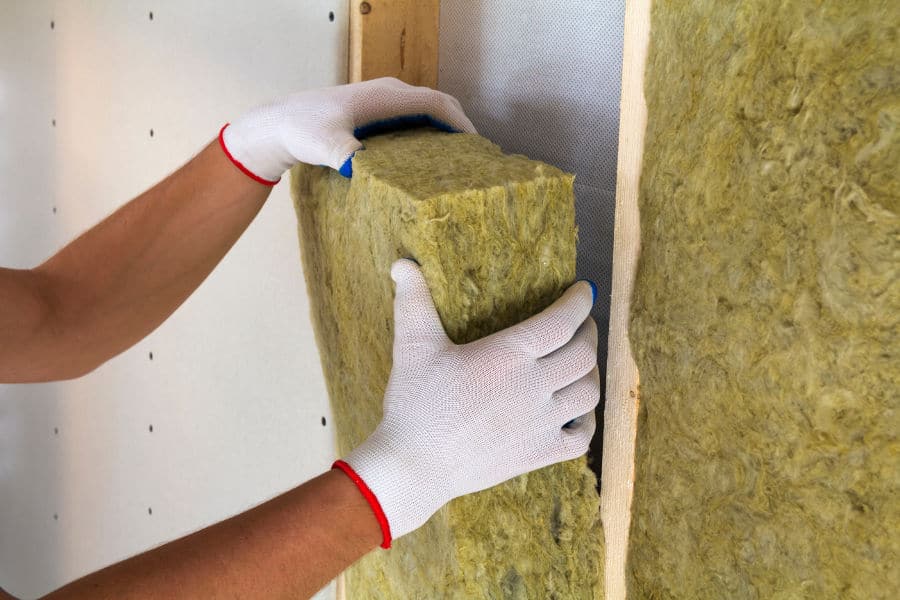
Sound Absorption Property of Stonewool
Sound or voice, which is one of the types of energy, is created by the motion of material particles; a particle in motion and colliding with another particle causes the other particle to move and produces sound.
Sound is produced from the vibration of air molecules.
In a building, the sound that reaches the ear from an adjacent building or outdoor space is called structure vibration.
(In fact, sound vibration is transmitted to the structure, and the structure starts to vibrate, air molecules start to vibrate, and the sound reaches the ear.)
In fact, insulation installers prevent structural vibration.
What is the reason for using stone wool insulation to prevent sound?
Due to its intertwined fibers, stone wool possesses the property of absorbing vibrations.
Stone wool insulation has a very good sound absorption and reduction coefficient. That's why it is used in sound insulation for airports, recording studios, conference rooms, studios, subway and urban metro tracks, etc.
The environment that is insulated has several advantages:
- Air vibration hitting the stone wool causes it to vibrate, preventing the transfer and displacement of sound due to its non-conducting properties.
- If excessive sound is produced, the vibrations of air molecules reaching the stone wool will be absorbed by the stone wool fibers, converting the sound into heat.
The most important reason for using stone wool in construction is its sound absorbing properties.
Stone wool also performs well as a moisture barrier. This type of insulation can absorb a large amount of moisture, preventing walls and ceilings from becoming damp.
An important feature of stone wool insulation is its resistance to fire. Stone wool insulation has an open fiber structure that is very suitable for reducing sound transmission and absorption.
The best way to use stone wool in construction is to use double-wall constructions instead of single-wall constructions.
This means using double walls and employing stone wool between them, as stone wool absorbs sound and prevents all air vibrations.
Note:
An important point in using stone wool insulation: if insulation is done incorrectly, the sound absorption efficiency will be reduced.
Finally, if adjacent walls, external walls, and even the ceiling of the building are insulated with stone wool, it has a 90% sound absorption capability.
And the remaining 10% are sounds that are inaudible to the human ear.