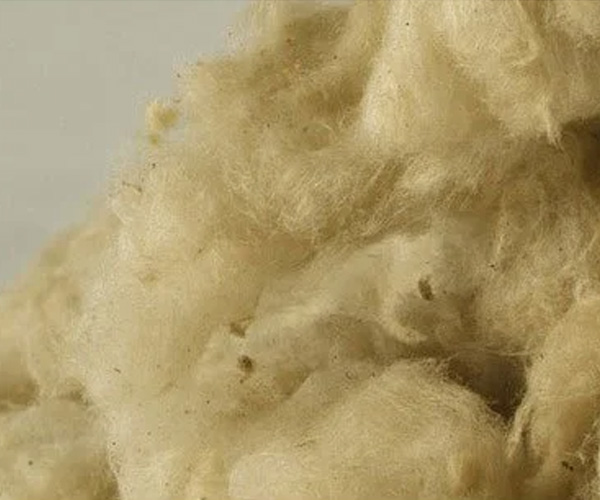
Raw Bulk Stonewool (Raw wool or Raw Bulk Rockwool)
Raw rock wool originates from the melting of basalt rock. This melting is achieved by burning a substance called coke. Purchasing coke constitutes the highest expense for rock wool producers.
Next, coke is introduced into the furnace for burning, and the heat produced from burning the coke melts the basalt rock. As a result of the centrifuge process, the molten material is converted into fibers, some of which can reach a length of 1.5 meters. Since no further processing has been performed at this point, these fibers are called raw rock wool. The raw wool fibers obtained through the centrifuge process create a very high cohesion in various rock wool products, improving their quality, preventing shedding, and ultimately giving the final product a long lifespan.
The approximate density of raw wool under normal conditions and before compression and molding is 15 kilograms per cubic meter, and since it has not taken shape yet, the density is not fixed.
Raw rock wool
Another example of raw wool is called slag wool. Unlike raw wool that originates from basalt rock, slag wool is produced from the melting of blast furnace slag (the by-product of iron extraction from blast furnaces).
Then this slag is melted at a temperature of 1400 degrees Celsius, resulting in its transformation into fibers. It is worth noting that the centrifuge process is not used in the production of slag wool, so the length of the slag wool fibers is very short. The product resulting from this type of wool starts to shed from the installation stage in structures and is soon lost, requiring re-insulation.
Raw wool is the primary material for all rock wool products. For example, when a substance called resin is added to raw wool and compacted, a product called flat rock wool or phenolic panel is created. Alternatively, by sewing raw wool with a non-combustible yarn onto galvanized mesh, rock wool blankets or isoblankets are produced.